Start with function. A hemostat clamps, a needle holder grips a suture needle, and a retractor holds tissue aside. Then compare the working end, length, curvature, and model or catalog number against the count sheet.
Look inside the jaws. A Kelly has transverse serrations on the distal half, nearest the tip. A Crile has serrations along the full jaw. Gold finger rings can suggest tungsten carbide inserts; verify the material against the exact model record.
Two ring-handled clamps have the same length and curvature. Which feature would help you distinguish them?
Follow the inspection points
Trace a hemostat from the jaw tips to the box lock and ratchet. Inspect for soil, cracks, wear, and misalignment. Check movement and engagement using the prescribed method. On a tungsten carbide needle holder, inspect both inserts for cracks, looseness, or worn tread.
On thumb forceps, examine each tooth, its opposing space, alignment, and spring action. On scissors, inspect the pivot and follow both cutting edges through the distal tips. Select the test material and technique specified for the instrument and test product.
A pair of scissors starts a clean cut, then catches at the tip. What finding would you document, and where should the instrument go?
Inspect blades and identification marks
Compare the same manufacturer and size when identifying a vaginal speculum. In the small Sklar models shown, both blades are 3 inches long. The Graves blade is ¾ inch wide and the Pederson blade is ½ inch wide. Check both blade surfaces, edges, alignment, screws, and movement on the instrument at hand.
Look closely at areas where a mark meets the instrument. Tape can lift, coatings can chip, and etched tracking identifiers can become illegible. Follow the instrument and marking manufacturer’s instructions for the approved method and placement.
What would you inspect beneath the lifted edge of identification tape?
Trace hidden pathways and insulation
Identify the exact powered handpiece, battery, attachment, and compatible charger. Similar fittings can belong to different systems. Use the relevant IFU for each component.
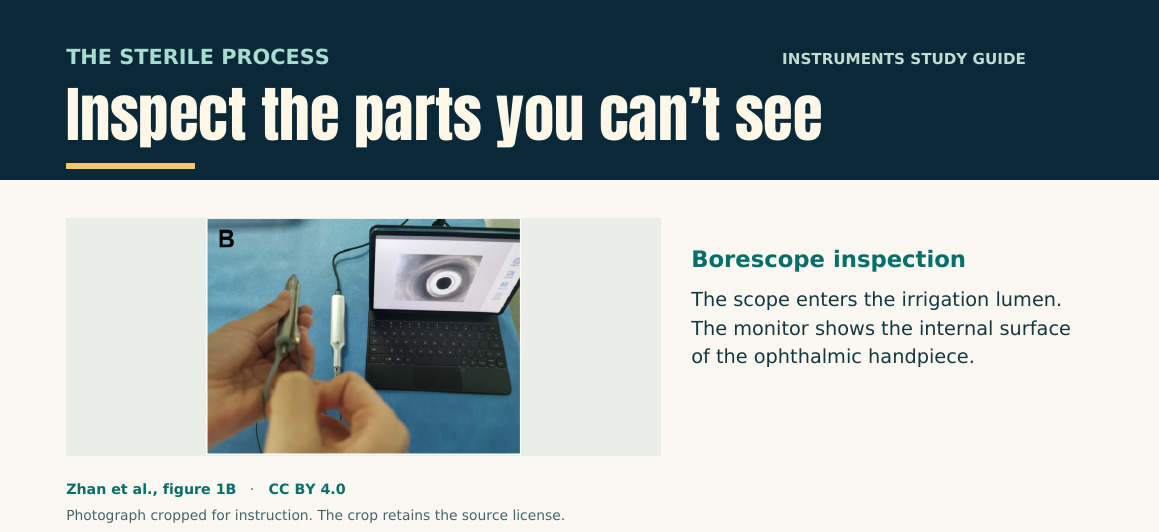
Examine the insulated shaft, metal-to-insulation junction, working end, and cord. Small defects can escape visual inspection. Use the appropriate insulation tester and settings when specified. For a lumened device, a compatible borescope can show accessible internal surfaces. The lecture demonstrates this with an ophthalmic handpiece.
A laparoscopic instrument looks clean and its jaws move smoothly, but its insulation fails testing. Which finding determines your next action?
Make a processing decision
At receipt, match a loaned set to the case and vendor inventory. Record missing or damaged items, obtain the applicable instructions, and allow time for required processing. Escalate a late arrival or missing instructions through the facility’s process.
Retained soil requires recleaning and another inspection. A cracked part or failed function test requires holding the item for qualified evaluation. Document the finding so the next person knows why the item was held.
A loaned set arrives wrapped shortly before the case. What must you verify before it can be released for use?
Use the assigned manufacturer IFU
For this document exercise, open the four-page Aesculap AdTec needle holder IFU, TA011172, version 6, dated March 2013. Use the PDF viewer’s page numbers and the document’s section headings to record your evidence.
Read a table’s heading, complete row, units, configuration, and footnote together. Keep each answer tied to this device and study edition. Clinical use requires the current instructions applicable to the individual device, equipment, and location.
If the family IFU does not list a specific catalog number, what would you need to verify before applying it to a physical instrument?
Knowledge check
16 practice questions
Question 1 of 16
Complete these 16 CRCST-aligned practice questions, then submit to see your score and explanations.
Use the same study document shown in the lecture. Your practice responses stay in this browser. Enrolled students submit their work through the course for instructor review.
Read the full four-page manufacturer IFU. Answer in your own words and cite the PDF viewer page and section heading for each response. If the document omits information, identify the gap and name the source you would use to resolve it. This open-book exercise requires no instrument handling.
01Identify the document
Record the manufacturer, instrument family, document identifier, version and date. Does this PDF provide a complete catalog-number coverage list? If not, explain what you would verify before using it for a physical instrument.
02Prepare for cleaning
What preparation does the disassembly section specify before reprocessing? Explain why a technician should not add extra disassembly steps from memory.
03Locate a cleaning pathway
Use the manual pathway with ultrasound and immersion disinfection. Identify the brush and syringe requirement, ultrasonic frequency, and minimum ultrasonic time. Explain why those details alone are not the complete cleaning procedure.
04Interpret two restrictions
Find two cleaning-related warnings or restrictions. For each, state the instruction and explain the processing decision it changes. Cite both locations.
05Inspect and respond
Identify what must be checked after cleaning, disinfection and drying. Explain the required response to remaining soil and to a damaged or inoperative instrument.
06Read the complete U.S. cycle row
Using only the U.S. sterilization section, record the method, both listed Fahrenheit temperatures, exposure time, minimum drying time, and named tray/container configuration. Explain why these values cannot be generalized to all instruments.
07Make a supported decision
Case: After processing, one needle holder has visible residue at the jaw and a second has a cracked handle. A coworker suggests packaging both because the planned steam cycle will handle the problem. What should happen to each instrument, and why?
Your draft saves on this device as you type.
Surgical instruments
The Sterile Process · IFU assignment · learner copy
Assigned IFU: TA011172, Version 6, March 2013
1. Identify the document
Record the manufacturer, instrument family, document identifier, version and date. Does this PDF provide a complete catalog-number coverage list? If not, explain what you would verify before using it for a physical instrument.
Response [Blank]
PDF page and section [Blank]
2. Prepare for cleaning
What preparation does the disassembly section specify before reprocessing? Explain why a technician should not add extra disassembly steps from memory.
Response [Blank]
PDF page and section [Blank]
3. Locate a cleaning pathway
Use the manual pathway with ultrasound and immersion disinfection. Identify the brush and syringe requirement, ultrasonic frequency, and minimum ultrasonic time. Explain why those details alone are not the complete cleaning procedure.
Response [Blank]
PDF page and section [Blank]
4. Interpret two restrictions
Find two cleaning-related warnings or restrictions. For each, state the instruction and explain the processing decision it changes. Cite both locations.
Response [Blank]
PDF page and section [Blank]
5. Inspect and respond
Identify what must be checked after cleaning, disinfection and drying. Explain the required response to remaining soil and to a damaged or inoperative instrument.
Response [Blank]
PDF page and section [Blank]
6. Read the complete U.S. cycle row
Using only the U.S. sterilization section, record the method, both listed Fahrenheit temperatures, exposure time, minimum drying time, and named tray/container configuration. Explain why these values cannot be generalized to all instruments.
Response [Blank]
PDF page and section [Blank]
7. Make a supported decision
Case: After processing, one needle holder has visible residue at the jaw and a second has a cracked handle. A coworker suggests packaging both because the planned steam cycle will handle the problem. What should happen to each instrument, and why?
Response [Blank]
PDF page and section [Blank]
The full training program
Continue your training
Build on this module with the full sterile processing curriculum, instructor feedback, exam preparation, and career support.
PayPal Pay Later, PayPal Credit, Afterpay, and Klarna are available for eligible purchases, subject to approval.